

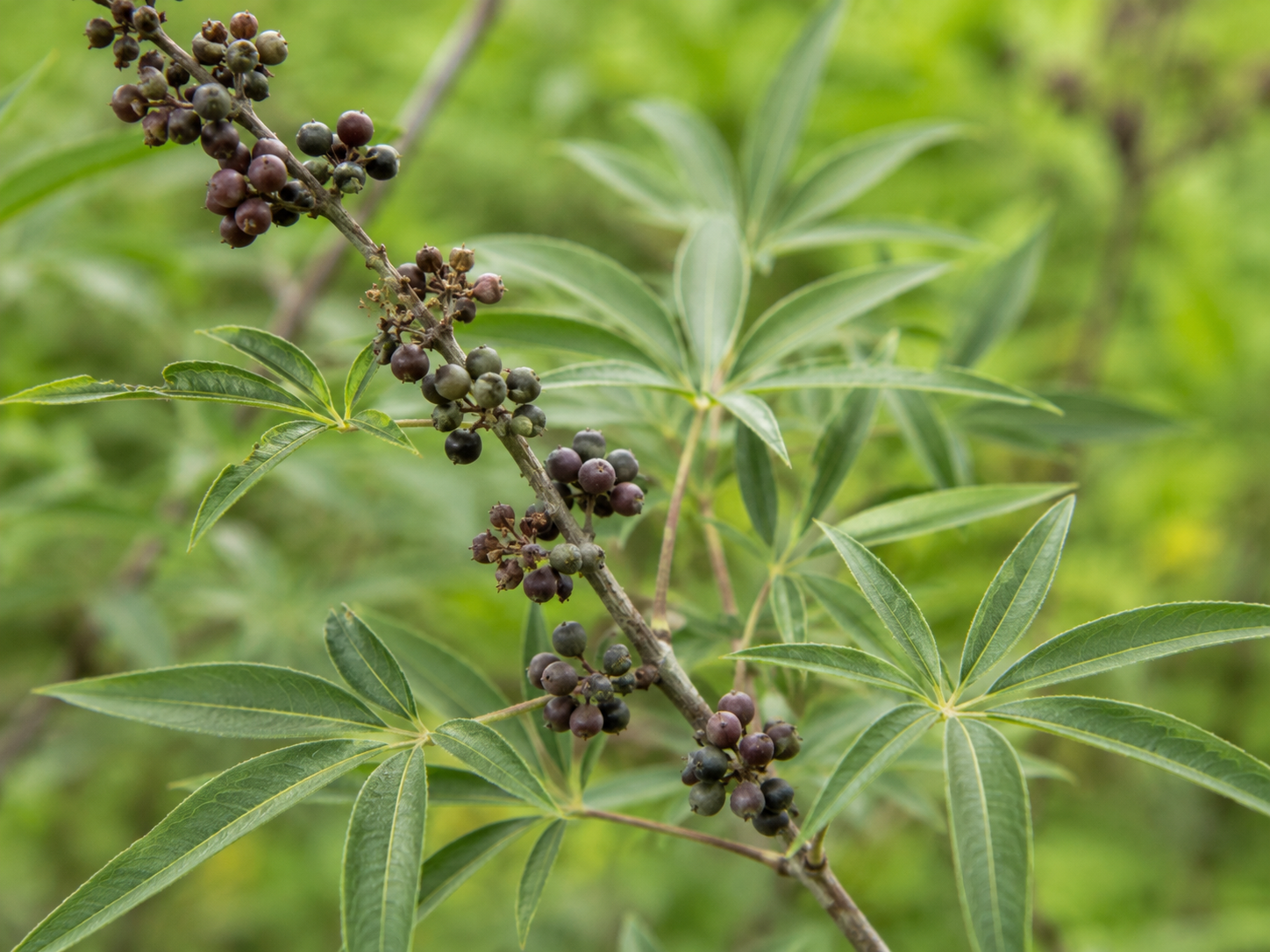
Chaste Tree Berry for Dogs and Cats: Grounded Glandular and Hormonal Support
Chaste Tree Berry for Dogs and Cats: Ingredient Profile, Uses, and Safety
Explore this LivHerbals ingredient profile for Chaste Tree Berry (Vitex agnus-castus). Learn about its traditional hormone-balancing uses, pet-specific research, and key safety facts.
Understanding Chaste Tree Berry in Pet Wellness
Chaste Tree Berry (Vitex agnus-castus) is a respected traditional fruit native to the Mediterranean region and Central Asia, where it has been cultivated, prized, and used in herbal medicine for over 2,500 years. Historically used to support hormonal balance and reproductive vitality, this small, pepper-like berry holds a unique place in botanical history. In modern pet herbal wellness, Chaste Tree Berry is primarily used as a specialized endocrine tonic to support normal pituitary gland function, promote structural hormone balance, and maintain a calm, settled demeanor during normal hormonal fluctuations. Pet parents most often encounter this botanical in veterinarian-guided wellness conversations related to senior vitality, endocrine support, hormonal balance, reproductive cycle support, and glandular stability.
Chaste Tree Berry is a highly active neurological and hormonal botanical. It carries specific safety cautions related to pregnant animals, prepubertal pets, and pets with hormone-dependent health challenges. Reviews highlight its ability to interact with dopamine receptors and influence progesterone pathways, which means it deserves care, precision, and proper situational use. For this reason, Chaste Tree Berry should not be used casually, in high or unmeasured serving sizes, or without veterinary guidance. It is not a broad-spectrum daily multivitamin. It is a focused botanical tool that works systematically to support equilibrium. By understanding both its glandular-balancing qualities and its safety parameters, pet parents can make informed decisions with the supervision of their trusted veterinarian.
Ingredient Identification
-
Common name: Chaste Tree Berry, Chasteberry, Vitex
-
Botanical name: Vitex agnus-castus
-
Plant family: Lamiaceae, Mint family, formerly classified under Verbenaceae
-
Plant part used: Dried ripe fruit, or berries
-
Other common names: Monk's pepper, chaste tree fruit, Abraham's balm
-
Native range: Mediterranean basin, Southern Europe, and Central Asia
-
Common growing regions: Warm temperate and subtropical climates globally
-
Common preparation forms: Standardized liquid extracts, alcohol-free glycerites, tinctures, and dried powders
-
Main active constituents: Diterpenes, such as rotundifuran, iridoid glycosides, including aucubin and agnuside, flavonoids, including casticin, and volatile oils
Associated Pet Wellness Categories
-
Endocrine and Pituitary Gland Support: Chaste Tree Berry is extensively studied for supporting normal pituitary gland function and maintaining healthy communication between the brain and endocrine organs. The pituitary gland regulates important hormones that influence energy, thirst, and coat health. It is often discussed when a senior pet needs support for metabolic balance and endocrine longevity during the natural aging process.
-
Hormonal Balance and Mood Support: This berry is traditionally used to support a balanced demeanor and normal behavior patterns during natural hormonal shifts. Intact female animals may experience behavioral moodiness or nervous tension associated with normal reproductive cycles. Chaste Tree Berry interacts with central pathways to help support cyclical nervous system balance, allowing pets to feel more grounded and settled in daily life.
-
Skin and Coat Health Maintenance: As an endocrine-supportive botanical, Chaste Tree Berry indirectly assists in maintaining normal skin moisture and healthy hair follicle cycles, especially in aging pets. When glandular function changes, pets may show coat texture changes or shedding imbalances. By supporting normal hormone communication, this berry helps promote a healthy coat from the inside out.
-
Homeostatic Fluid Balance Support: Chaste Tree Berry is used in holistic contexts to support normal thirst and healthy urination patterns. Glandular changes in senior animals can sometimes disrupt how the body manages water retention and elimination. This botanical helps support normal signaling pathways, promoting comfortable fluid dynamics and systemic vitality.
Common Pet Wellness Uses
-
Cyclical Behavioral and Mood Support: Chaste Tree Berry has a long, documented history of use as an endocrine-modulating botanical. In intact female dogs, it is used to support an even, relaxed temperament and comfort during normal seasonal cycles. The evidence level is considered strong for its general dopaminergic mechanism of action, though still emerging for pet-specific clinical trials.
-
Senior Pituitary Axis Maintenance: Chaste Tree Berry is frequently used in holistic veterinary practice for senior pets requiring foundational support for normal pituitary and adrenal axis function. The evidence is supported by traditional use, equine models evaluating pituitary health, and small animal clinical experience cited in veterinary botanical texts.
-
Vibrant Hair Coat Regulation: In holistic canine practice, Chaste Tree Berry extract is sometimes used to support older dogs experiencing age-related shedding delays or coat texture changes, helping maintain normal hair growth cycles through internal glandular support.
Best Known Herbal Actions
-
Dopaminergic Modulator: This action refers to the herb's researched ability to interact with dopamine D2 receptors in the pituitary gland. By mimicking dopamine, Chaste Tree Berry helps support the normal regulation of prolactin secretion, assisting the body in maintaining a balanced endocrine feedback loop.
-
Hormone Balancer: Chaste Tree Berry helps support the body's natural pathways that maintain balance between progesterone and estrogen. Rather than introducing synthetic hormones, it encourages the pet's own glandular system to support homeostatic balance.
-
Endocrine Tonic: A tonic is traditionally used to restore, tone, and support specific organs or systems over time. Chaste Tree Berry acts as a slow, deep-acting tonic for the hypothalamic-pituitary-gonadal axis, supporting long-term structural resilience.
Key Constituents and Why They Matter
The primary active compounds found in Chaste Tree Berry include diterpenes, iridoid glycosides, and flavonoids. The most significant diterpene is rotundifuran, which research indicates is primarily responsible for the berry's ability to bind to dopamine receptors and support normal prolactin regulation. The iridoid glycosides, most notably agnuside and aucubin, serve as quality and standardization markers for extracts. The flavonoids, especially casticin, provide antioxidant support and help maintain a healthy cellular life cycle within glandular tissues. This means Chaste Tree Berry works systemically to support hormone pathways, brain-to-organ signaling, and cellular integrity.
Western Herbalism Profile
In Western herbalism, herbs are classified by taste, energetics, and tissue affinities to guide how they interact with the body. Chaste Tree Berry is characterized by a bitter, acrid, spicy, and warm taste. Energetically, Western herbalists consider Chaste Tree Berry warming in temperature and drying in nature. It has a pronounced tissue affinity for the pituitary gland, reproductive organs, and central nervous system.
Western herbalists have long indicated Chaste Tree Berry for endocrine stagnation, hormonal irregularities, cyclical irritability, and fluid imbalances. It is viewed as an herb that clears cold stagnation from glandular tissues, stimulates normal communication pathways, and restores a more even baseline to an over-reactive system. It helps bring order and calm back to an ungrounded endocrine pattern.
Western herbalists also maintain clear boundaries around its use. Because of its warming, drying nature and highly active terpene fractions, it is formulated to work gradually over weeks and months rather than as a rapid intervention. It is designed as a foundational tonic during hormonal or age-related shifts. Herbalists advise monitoring its drying qualities carefully in thin, frail, or naturally dry animals.
Traditional Chinese Medicine Profile
Because Chaste Tree Berry is native to the Mediterranean basin, it is not a classical herb found in the ancient Traditional Chinese Medicine (TCM) materia medica. TCM uses a close relative known as Man Jing Zi (Vitex trifolia), and modern TCM practitioners and holistic veterinarians evaluate Chaste Tree Berry using similar energetic principles to understand how it behaves in small animals.
Through a modern TCM lens, practitioners view Chaste Tree Berry as having a pungent, bitter flavor paired with cool to warm, drying energy. It is believed to primarily enter the Liver, Kidney, and Heart meridians. In TCM, the Liver controls the smooth flow of Qi and emotions, while the Kidneys store foundational Yin, Yang, and Jing, or essence, that govern aging and reproduction. When a pet shows cyclical irritability, coat changes, or metabolic stagnation, the system is often considered affected by "Liver Qi Stagnation" and disharmony in the Chong and Ren meridians, the pathways associated with hormonal cycles. Chaste Tree Berry's traditional role is viewed as smoothing Liver Qi, regulating the Chong and Ren channels, and anchoring upward-floating heat.
Its grounding qualities also help stabilize the Shen, or spirit, when behavioral changes occur. Despite these useful actions, TCM practitioners follow a clear rule: do not use in cases of severe Kidney Yin deficiency with active empty heat. If an animal is profoundly dry, depleted, or showing signs of internal heat without stagnation, the drying nature of Vitex is considered inappropriate because it could further deplete vital fluids.
Ayurvedic Medicine Profile
While Chaste Tree Berry is not native to the Indian subcontinent and does not appear in classical ancient Ayurvedic texts, modern Ayurvedic practitioners and holistic veterinarians sometimes analyze this Western botanical using Ayurvedic principles to understand its impact on the three doshas: Vata, Pitta, and Kapha.
From an Ayurvedic perspective, Chaste Tree Berry is recognized for its pungent and bitter tastes (rasa), heating energy (virya), and pungent post-digestive effect (vipaka). Its primary doshic action is strongly pacifying to Vata and Kapha, while potentially increasing Pitta if used in excess. Vata dosha rules the nervous and endocrine systems. When aggravated by aging or stress, it appears as erratic behavior, dryness, and unpredictable hormonal signals. Kapha rules structure and fluid stability. When stagnant, it leads to tissue accumulation and metabolic sluggishness. Chaste Tree Berry's heating, drying, and light properties directly counteract these imbalances, helping clear metabolic dampness, warm Vata coldness, and steady erratic nervous impulses in the brain.
Ayurvedic practitioners view Vitex as an endocrine Rasayana, or rejuvenative, reinforcing communication channels between Majja Dhatu, or nervous tissue, and Shukra Dhatu, or reproductive tissue. Because it is energetically heating, it should be monitored in pets with high Pitta imbalances, such as active skin heat, hot temperaments, or acid digestive traits, to ensure it does not overheat the internal metabolic fire.
Research Summary
It is important to acknowledge that double-blind, peer-reviewed clinical trials evaluating Chaste Tree Berry directly in dogs and cats are currently limited, though steadily growing. The botanical is recognized in holistic veterinary manuals and equine research for supporting large and small animals during endocrine transitions.
-
Animal Research: Studies in equine and rodent models demonstrate that Chaste Tree Berry extracts support normal pituitary gland function, assist in maintaining healthy cortisol levels under stress, and help regulate prolactin secretion.
-
Human Research: Multiple placebo-controlled, double-blind clinical trials have evaluated Chaste Tree Berry extract for cyclical mood changes, progesterone-to-estrogen balance, and normal menstrual regularity.
-
In Vitro Research: Laboratory studies have demonstrated that the diterpenes in Chaste Tree Berry bind selectively to dopamine D2 receptors, supporting its traditional role as a natural dopaminergic pathway modulator.
A significant gap remains in large-scale small animal pharmacokinetic safety data. Human and equine research provides directional insight, but it does not guarantee pet efficacy or safety without veterinary guidance.
What the Research Means for Dogs
For dogs, the most relevant wellness categories for Chaste Tree Berry are senior endocrine support and cyclical mood management in intact females. Older dogs can experience gradual shifts in the pituitary axis that may appear as coat changes, increased thirst, or variable energy levels. The strongest support for Chaste Tree Berry's use comes from its documented dopaminergic mechanism, making it relevant for dogs requiring ongoing glandular stability. The weakest support lies in the lack of multi-center canine clinical trials validating exact standardized extract serving ranges. Due to its direct impact on hormone feedback loops, canine metabolic baselines should be evaluated. Chaste Tree Berry may be helpful for aging dogs, but veterinary oversight is necessary to rule out primary adrenal diseases or other conditions that require conventional medical care.
What the Research Means for Cats
In cats, Chaste Tree Berry requires high caution and restricted use. Cats have a sensitive endocrine network, and their liver processing pathways can make them reactive to active plant diterpenes and volatile compounds. While senior cats experiencing glandular fluctuations or vocalization could theoretically benefit from the grounding and regulating properties of this berry, there is a lack of feline-specific safety trials. Chaste Tree Berry also has an acrid, intensely bitter profile that can trigger hypersalivation, or drooling, and food avoidance if not fully hidden within a capsule. Evidence for its use in cats is supported mostly by holistic veterinary texts and clinical experience, making a veterinarian's explicit guidance essential before introducing Chaste Tree Berry to a cat.
Forms Used in Pet Wellness
-
Powder/Capsule: Used to deliver whole-berry benefits or concentrated extracts standardized to agnuside content. This form is easier to measure accurately and may be mixed into wet food to help hide the pungent flavor from sensitive noses.
-
Tincture/Glycerite: Liquid extracts allow precise, drop-by-drop measuring. Alcohol-free glycerites are often preferred for small pets because the natural sweetness of glycerin helps offset the berry's acrid and bitter flavor.
-
Topical: Chaste Tree Berry is not used topically in small animal pet applications.
-
Chews: Chew formats are sometimes used in pet wellness for palatability and daily administration when appropriate for the individual pet.
Safety Profile
Chaste Tree Berry is an endocrine-active botanical, and its general safety profile requires respect. It is associated with interacting with dopamine receptors and influencing sex hormone pathways.
-
Dogs: Generally well-tolerated when introduced gradually at appropriate serving sizes, but should be monitored for temporary digestive shifts or mild skin itchiness.
-
Cats: Requires high caution, low serving sizes, and strict professional monitoring due to sensitive feline endocrine systems and liver processing constraints.
-
Puppies, Kittens, Pregnant or Nursing Pets: Avoid entirely. Chaste Tree Berry can alter uterine tone and disrupt normal gestation hormones, creating risk for pregnant or breeding animals.
-
Pets with Hormone-Dependent Tumors: Avoid entirely. Because Chaste Tree Berry influences estrogen and progesterone pathways, it should not be given to pets with a history of mammary tumors or hormone-sensitive conditions unless specifically directed by a veterinarian.
-
Possible Adverse Effects: Mild gastrointestinal irritation, temporary changes in energy levels, loose stools, or excessive drooling if the bitter flavor contacts the tongue.
-
When to Stop Use: Discontinue and consult a veterinarian if the pet shows vomiting, severe behavioral shifts, unexpected skin rashes, or changes in baseline water consumption.
Please note: Before beginning any pet supplements, herbs, or nutritional changes, consult your veterinarian first. This educational information is intended to support informed conversations with your veterinary team and should not replace professional guidance.
Contraindications
-
Pregnancy, lactation, and breeding animals.
-
Prepubertal puppies and kittens.
-
History of hormone-dependent neoplasms, such as mammary tumors.
-
Severe Kidney Yin deficiency with active empty heat patterns.
Drug and Supplement Interactions
-
Dopamine Antagonists and Agonists: Chaste Tree Berry may interfere with or increase the effects of medications that affect dopamine pathways, such as metoclopramide or phenothiazines, altering their effectiveness.
-
Exogenous Hormones: Chaste Tree Berry should not be combined with prescription hormone therapies, progesterone treatments, or reproductive medications unless directed by an endocrine specialist.
-
Antipsychotic Medications: Chaste Tree Berry may theoretically interact with behavioral pharmaceuticals that use dopamine receptors, requiring veterinary evaluation.
Dosage and Serving Context
Serving context depends heavily on species, weight, individual endocrine baseline, and whether the herb is prepared as a raw dried berry powder or concentrated liquid extract. There is no generic household measurement for Chaste Tree Berry. Standardized extracts are significantly more potent than raw powders. When reference ranges are used, veterinary botanical texts focus on total pet weight (mg/kg) divided daily. Chaste Tree Berry is typically given consistently at the same time each day with a meal to support smooth absorption and stable systemic levels. For the safest and most appropriate use, discuss Chaste Tree Berry with your veterinarian before giving it to your dog or cat. Your veterinarian can help evaluate your pet's health history, medications, age, endocrine status, reproductive status, hormone-related risks, and wellness needs before use.
How This Ingredient Fits into BARC Formulas
At LivHerbals, ingredients like Chaste Tree Berry are approached with care, respect for traditional use, and attention to pet-specific safety considerations. When an ingredient is used in a BARC formula, it is selected for a specific wellness purpose and balanced within the larger formula rather than treated as a standalone quick fix.
Ingredient Profile Summary
-
Best known for: Supporting normal pituitary gland function and hormonal balance.
-
Most relevant pet wellness categories: Endocrine support, senior vitality, cyclical behavior balance.
-
Most relevant herbal actions: Dopaminergic modulator, hormone balancer, endocrine tonic.
-
Research strength: Strong in animal, equine, and human models. Growing in small animal clinical validations.
-
Main cautions: Chaste Tree Berry is supportive for age-related glandular changes, but it should be used carefully. It should never be given to pregnant animals and is contraindicated in pets with hormone-dependent conditions unless specifically directed by a veterinarian. Use this herb under veterinary guidance to support your pet's safety and well-being.
Pet Parent Takeaway
Chaste Tree Berry is a traditionally revered botanical known for supporting endocrine pathways, brain-to-organ communication, and normal hormonal shifts. When a senior dog is navigating age-related coat changes, or an intact female pet needs support for an even temperament during normal cycles, Chaste Tree Berry may offer steady support within a broader wellness plan. It is a highly focused tool rather than a casual treat. To use Chaste Tree Berry safely and appropriately, partner with your veterinarian and consider your pet's full health picture before starting any new herb or supplement.
Disclaimer: This content is for educational purposes only and is not intended to diagnose, treat, cure, or prevent any disease. Always consult your veterinarian before starting any new supplement, herb, food, or wellness routine for your pet, especially if your pet is pregnant, nursing, taking medication, has a diagnosed condition, or is under veterinary care.
References
Pet-Specific Studies and Veterinary References
-
Wynn, S. G., & Fougère, B. J. (2007). Veterinary Herbal Medicine. Mosby Elsevier.
-
Basko, I. (2004). Fresh Plant Materia Medica.
Human and Animal Studies
-
Schellenberg, R. (2001). Treatment for the premenstrual syndrome with chaste tree fruit extract: Prospective, randomised, placebo controlled, double blind study. BMJ.
-
Meier, B., et al. (2000). Pharmacological activities of Vitex agnus-castus extracts in vitro. Phytomedicine.
Safety and Toxicology References
-
American Herbal Products Association (AHPA). Botanical Safety Handbook (2nd ed.).

Written by Angela Petersen
.%20Learn%20about%20its%20traditional%20hormone...)